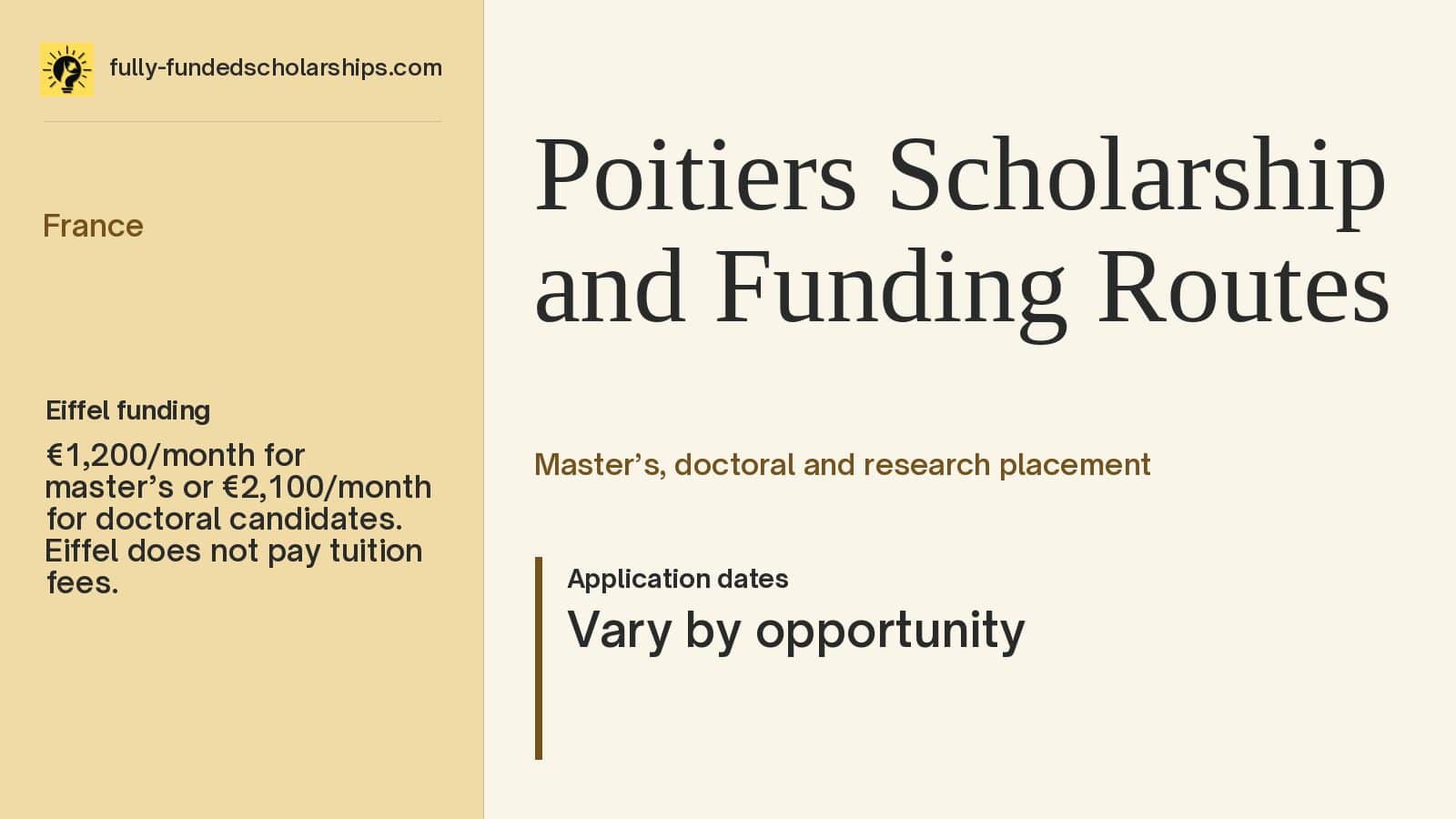
University of Poitiers 2027 Scholarships: Eiffel, SuCat and Research Funding Routes
The University of Poitiers guide covers three distinct opportunities in France: the 2027 France Excellence Eiffel Scholarship, SuCat’s 2027–2029 Erasmus Mundus master’s programme and funded incoming research internships through IntREE. Each has a different application route, selection process and funding package. Use the distinctions below to identify the right call and avoid confusing university nomination with admission or a guaranteed award.
Choose the right University of Poitiers application route
These are separate opportunities, not one combined scholarship application. Check the relevant call and its current requirements before preparing documents.
- For Eiffel, identify an eligible course or doctoral supervisor and follow the University of Poitiers screening and faculty-submission instructions. The university—not the applicant directly—decides whether to submit a nomination to Campus France. Prepare the listed academic records, recommendations, passport, CV and career plan; doctoral applicants also need a thesis proposal.
- For SuCat, submit the English application through the programme’s application page. The article lists degree or enrolment evidence, transcripts with grading scale, a two-page European-format CV, passport or eligible ID, a one-page motivation letter, two recommendations dated 2026/2027 and English evidence. Review participation costs and possible funding before accepting an offer.
- For IntREE, first arrange a research project with your home team and a University of Poitiers host. Complete the incoming mobility form and email it with a CV, motivation letter, latest diploma and supervisor’s acceptance letter to eur.intree@univ-poitiers.fr.
Check your application route
For Eiffel, prioritize contacting the relevant faculty or programme: the article gives 20 November 2026 at noon French time as the main Poitiers deadline, while a detailed page lists 23 November for several faculties. To manage that discrepancy, submit by the earlier date unless your faculty confirms otherwise. Do not treat Campus France’s later institutional deadline as extra time for an individual applicant.
Details for your application
- Opportunities
- Eiffel scholarship, SuCat master’s scholarships and IntREE incoming M2 research internships.
- Study and placement levels
- Eligible master’s, engineering and doctoral routes; IntREE placements are for external master’s students.
- Eiffel funding
- €1,200/month for master’s or €2,100/month for doctoral candidates. Eiffel does not pay tuition fees.
- SuCat funding
- Selected scholarship holders may receive €1,400/month for up to 24 months plus participation-cost support paid to the consortium. Admission does not guarantee a scholarship.
- IntREE support
- Potential €2,000 travel assistance and approximately €600/month for an incoming M2 research placement, subject to approval.
- Eligibility
- Conditions differ by route. Eiffel’s Poitiers master’s screening specifies non-EU applicants without French nationality, strong class standing and B2 French. SuCat accepts relevant bachelor’s degrees equivalent to at least 180 ECTS.
- Key application dates
- Eiffel: Poitiers reports 20 November 2026 at noon French time, but another page lists 23 November for several faculties. SuCat: 19 February 2027 at 23:59 Brussels time. IntREE incoming M2: year-round, subject to project agreement and funding approval.
- Official application information
- Eiffel: University of Poitiers call. SuCat: programme application page. IntREE: incoming mobility information on the master’s page.
Application dates vary by opportunity. Check the individual application links.
Adapted from DAADScholarship.com.