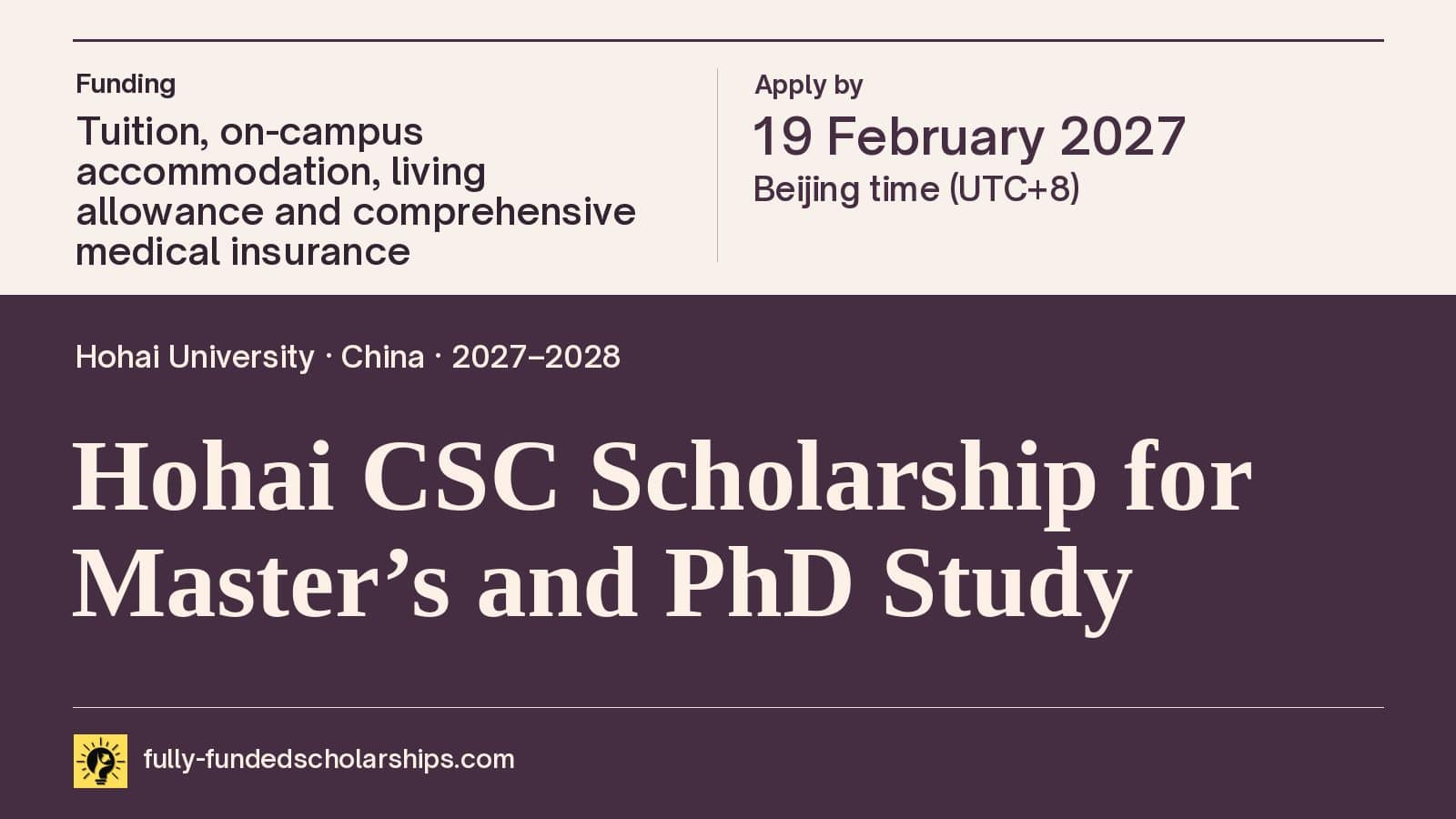
Hohai University CSC Scholarships 2027–2028: Master’s and PhD Study in China
If you want to build a research degree around water, engineering, computing or another advertised field, Hohai University’s Chinese Government Scholarship High-Level Graduate Student Program may help cover major study costs in China. The 2027–2028 call is open to eligible international master’s and PhD applicants. Your first practical decision is whether a Hohai supervisor is a good match: both degree routes require supervisor support before your university application is complete.
Start with supervisor support, then submit to Hohai
You need a complete university application first. The later CSC submission applies only if Hohai recommends you, so keep the two stages and their deadlines distinct.
- Choose an advertised English-taught programme at the degree level you seek. Check that your academic background supports the subject and that you meet the degree and age rules: bachelor’s degree and under 35 for master’s applicants; master’s degree and under 40 for PhD applicants. Non-Chinese citizenship and good physical and mental health are also required.
- Use Hohai’s supervisor directory to identify a research match. Ask the professor for both the signed pre-acceptance letter and the supervisor-signed study plan. The study plan must exceed 1,000 English words or Chinese characters and cover your academic background, study or work experience, and proposed graduate research.
- Assemble the documents, including your CSC form, academic records, two recommendations from professors or associate professors, English evidence if you are a non-native English speaker, health and police-clearance documents, and supporting records. Follow the call’s requirements for notarized translations where documents are not in Chinese or English. Do not assume an English-medium degree automatically waives language evidence; the source says to obtain Admissions’ approval before relying on alternative evidence.
- Complete the CSC form using Type B and agency number 10294. Then register through Hohai’s admissions portal or the alternative application address, enter your programme details, upload the complete file and pay the RMB 400 fee before 19 February 2027. The source says incomplete documents or unsuccessful payment prevent acceptance.
- If Hohai selects and recommends you after screening, academic review and an online interview, follow its pre-admission instructions and complete the later CSC stage by 25 March 2027. Hohai’s recommendation is not final CSC approval; successful applicants receive formal admission and JW201 documentation.
Check your application route
Do you need publications to apply? The source does not state a compulsory publication requirement. Hohai asks for a publication list and abstracts if you have them, so if you have no papers, show your preparation through your research proposal, projects and recommendations instead.
Details for your application
- Study levels
- Master’s and PhD
- Funding
- Tuition, on-campus accommodation, living allowance and comprehensive medical insurance
- Monthly stipend reference
- The source cites standard CSC rates of RMB 3,000 for master’s students and RMB 3,500 for doctoral students; Hohai’s brochure confirms an allowance but does not repeat its amount.
- Application fee
- RMB 400, non-refundable
- University deadline
- 19 February 2027, Beijing time (UTC+8); no closing hour is published
- Later CSC stage
- Recommended candidates must complete the later CSC application by 25 March 2027; this does not extend Hohai’s university deadline.
The application deadline for Chinese Government Scholarship High-Level Graduate Student Program at Hohai University is 19 February 2027 (Beijing time (UTC+8)).
Adapted from DAADScholarship.com.